When Your Yard Won’t Cooperate
Southwest Ohio isn’t flat. If you own a home in West Chester, Mason, Loveland, or anywhere along the Little Miami River valley, chances are you’re dealing with some kind of slope in your backyard. Maybe it’s a gentle grade that makes your patio feel lopsided. Maybe it’s a steep hillside that’s slowly washing away every time it rains.
Either way, you’ve probably wondered: do I actually need a retaining wall, or can I just live with it?
Here’s how to tell — and what to do about it if the answer is yes.
Signs You Need a Retaining Wall
Not every slope needs a wall. Some grades are gentle enough that proper landscaping and ground cover can handle them. But if you’re seeing any of these signs, it’s time to think about structural support.
Soil Is Moving Downhill
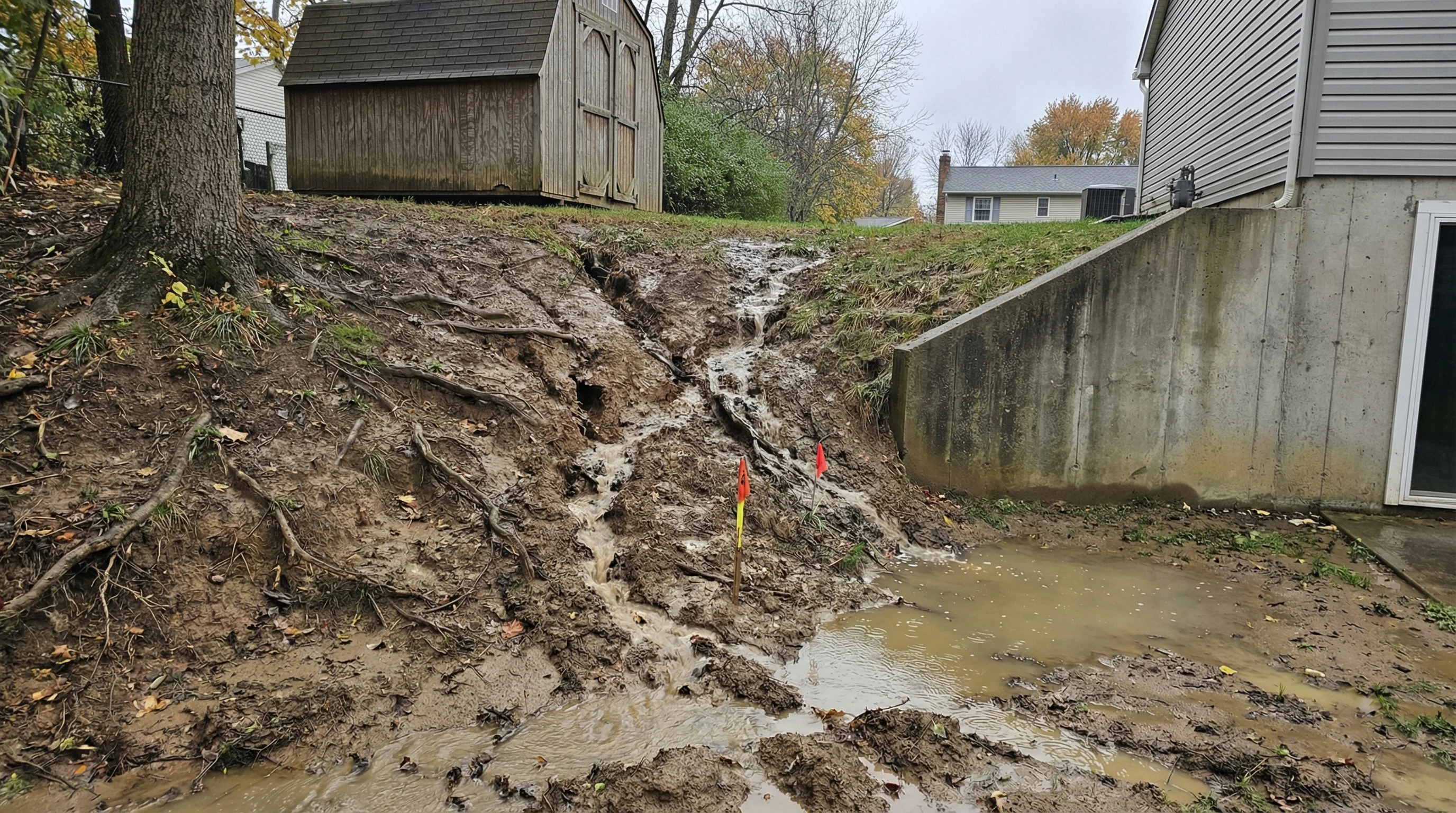
If you notice dirt, mulch, or gravel migrating down your slope after rain, that’s erosion in action. Over time, this gets worse — not better. Each heavy rain removes more soil, exposing root systems, undermining foundations, and depositing mud where you don’t want it.
In the Cincinnati area, our clay-heavy soils make this worse. Clay holds water like a sponge, gets heavy, and slides. A retaining wall stops this cycle by physically holding the soil in place.
Water Is Pooling Near Your Foundation
This is the one that gets expensive fast. If water is collecting against your foundation instead of draining away, you’ve got a grading problem. Left unchecked, this leads to basement leaks, foundation cracking, and mold issues that cost thousands to fix.
A retaining wall combined with proper regrading redirects water flow away from your home. It’s a one-time investment that prevents recurring damage.
You Can’t Use Part of Your Yard
Got a steep slope in your backyard that nobody can use? No room for a patio, a fire pit, a play area, or a pool? A retaining wall creates level space where there was none. We’ve turned unusable hillsides into patios, pool decks, and flat play areas for families across Warren and Butler counties.
Your Existing Wall Is Failing
Old retaining walls — especially those built with railroad ties, stacked landscape blocks without proper engineering, or dry-stacked stone — eventually fail. Signs include leaning, bulging, cracking, or visible gaps opening between blocks. If your existing wall is showing these symptoms, it’s not going to get better on its own.
Types of Retaining Walls We Build
Segmental Block Walls
These are the workhorses of residential retaining wall construction. Interlocking concrete blocks designed specifically for retaining walls — they’re engineered to handle the lateral pressure from soil and water. We use quality block systems rated for Ohio’s freeze-thaw cycles, with proper drainage behind the wall to prevent hydrostatic pressure buildup.
Tiered Walls
For taller slopes, a single tall wall isn’t always the best approach. Tiered walls — two or more shorter walls with terraced planting areas between them — distribute the load more effectively and look great. They also create opportunities for layered landscaping that adds real value to your property.
Natural Stone Walls
For homeowners who want a more organic look, we build with natural stone. These walls blend into the landscape and work well in garden settings, along driveways, and as decorative borders. They require more labor to build but the result is a wall that looks like it’s been there forever.
What the Installation Process Looks Like
Here’s what to expect when you hire us for a retaining wall project.
1. Site Assessment
We visit your property, look at the slope, check the soil conditions, identify drainage patterns, and talk about what you want to accomplish. This consultation is free and there’s no pressure.
2. Design and Quoting
Based on the assessment, we design a wall system that solves the problem. You get a detailed, line-by-line quote that covers materials, labor, excavation, drainage, and backfill. No vague estimates, no surprise charges.
3. Excavation and Base Preparation
We excavate the footing trench using our own equipment — no subcontractors. The base has to be right, because every course above it depends on a level, compacted foundation. We install a crushed stone base and make sure drainage stone and perforated pipe are in place behind the wall.
4. Wall Construction
Blocks go up course by course, with each layer checked for level and alignment. Geogrid reinforcement is used for taller walls to tie the structure back into the hillside. This is the engineering that separates a wall that lasts decades from one that leans within a few years.
5. Backfill and Grading
Once the wall is complete, we backfill behind it with drainage stone, cap it, and grade the surrounding area. If we’re creating a new level area above or below the wall, we finish-grade it and prep for topsoil and seed.
6. Cleanup
We clean up the site every day and haul away all excavated material and debris. When we’re done, the only thing you should notice is your new wall and a yard that finally works.
How Much Does a Retaining Wall Cost in Ohio?
Costs vary significantly based on wall height, length, material choice, and site accessibility. A small garden wall is a different project entirely from a 6-foot structural wall spanning 80 feet.
Here are the main factors that affect cost:
- Wall height and length — More material and more labor.
- Soil conditions — Clay, rock, or unstable soil can add excavation time.
- Drainage requirements — All structural walls need drainage; complex sites need more.
- Access — If we can drive equipment right to the work area, it’s faster and more affordable than if we’re hauling materials up a steep hillside by hand.
- Material choice — Concrete block is the most cost-effective. Natural stone costs more.
The best way to get an accurate number is to have us come look at your property. The consultation is free, the quote is detailed, and there’s zero obligation.
Don’t Wait Until It Gets Worse
Erosion doesn’t fix itself. Slopes don’t stop moving. Foundation drainage problems don’t improve with time. Every year you wait, the problem gets a little bigger and a little more expensive to fix.
If you’re seeing signs that your yard needs a retaining wall, the smartest time to address it is now — before the next round of spring rains makes it worse.
Need an honest assessment? Call Aquascapes at (513) 548-4253 or request a free consultation. We’ve been building retaining walls and handling excavation projects across Southwest Ohio for over 20 years, and we’ll tell you straight whether a wall is the right solution for your property.